Coauthored by Destination Missoula, Karen Sippy and Lisa Simon
Public art has a special space in the Missoula community. From large-scale displays like Sculpture Missoula and the Allez! mural project in downtown Missoula to small pieces scattered throughout the city, public art is ingrained in the identity of Missoula as a whole. And now, with the grand unveiling of the Downtown Riverside Art Walls (DRAW) Indigenous Murals Project, Indigenous artworks are visible in a big way in Missoula. Destination Missoula sat down with Karen Sippy, Project Manager of DRAW, to hear about the project’s origins and the challenges and successes that brought this project to fruition. We also have the honor of sharing the voices of the Indigenous artists’ whose creations bring vibrancy and new critical perspectives to the public art scene in Missoula.
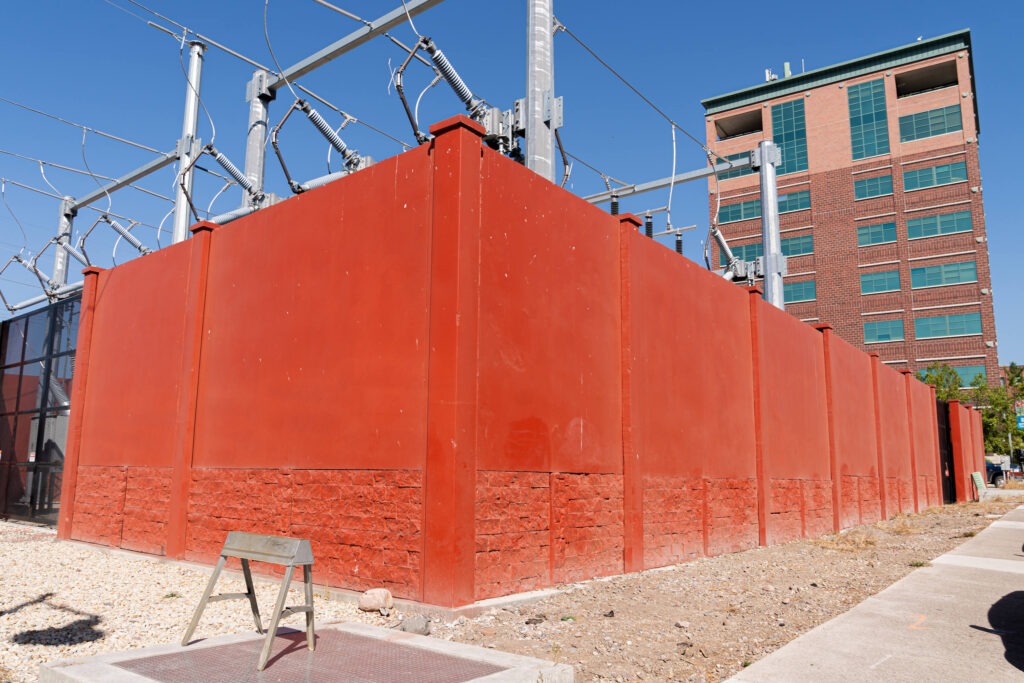
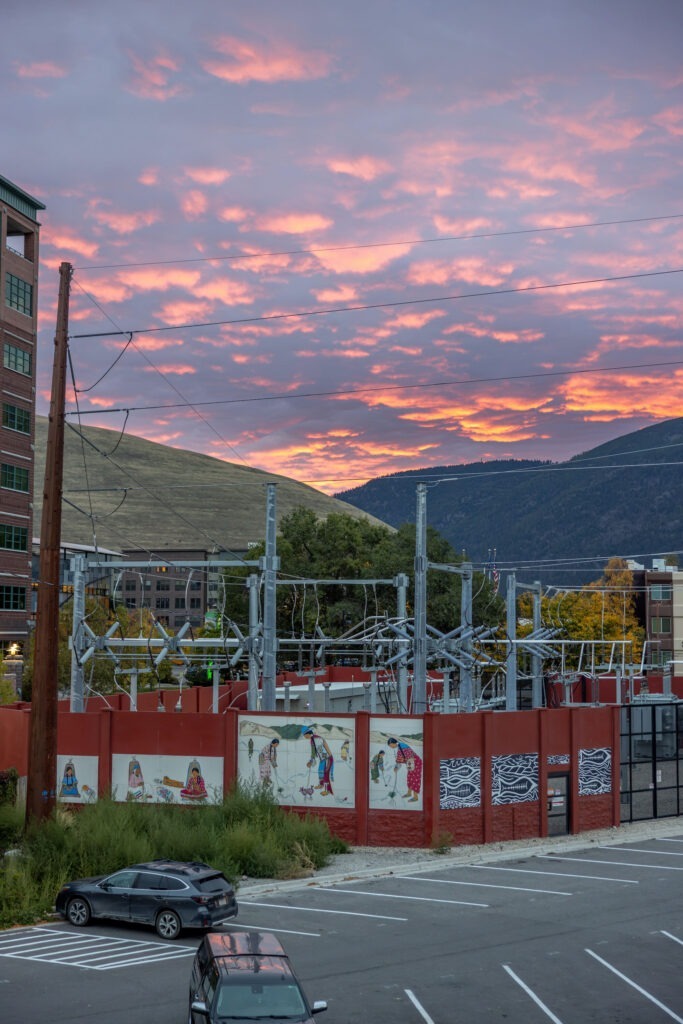
When NorthWestern Energy began planning upgrades to its downtown Missoula substation, the project came with a big visual change, and not a scenic one—15-foot concrete walls. The substation, located in downtown Missoula along the Clark Fork River near Caras Park and the Riverfront Trail system, formerly had chain-link and iron fencing that, while not pleasant to look at, was less visible than these tall concrete barriers. Where others might have seen a utility structure or an eyesore, Sippy saw a canvas and an opportunity. “We knew we wanted ‘big art’ on there,” Sippy said.
Sippy immediately remembered a conversation with her friend Lisa Simon of Radius Gallery, who had served on Missoula’s Public Art Committee. Simon as well as two Indigenous artists, Willow Kipp and Danielle Vasquez, had petitioned for prominently displayed Indigenous art representing Montana in downtown Missoula’s public art spaces. “When the opportunity was presented, the first call I made was to Lisa,” Sippy recalled. “I told her, ‘I have the location for your dream project.’”
That conversation was the beginning of DRAW as we know it today. The project eventually grew into an ambitious effort to transform the massive utility walls into a highly visible celebration of Indigenous art and language. Sippy recalls that one of the first major efforts, after the permitting process, was fundraising which turned out to be a breeze. “The project sold itself,” Sippy said of the community’s willingness to support. With the support of many donors, the project went from a dream to a big reality. Donors include the Sippy Family Foundation, Holiday Inn Downtown, Poteet Construction, Wayne Boeck, Missoula Parks & Recreation, Missoula Parking Commission, Destination Missoula and the Tourism BID, the Downtown BID, Radius Gallery, Blackfoot Communications, Kembel, Kosena & Co., Lambert Hotels, the Max & Betty Swanson Foundation, Stockman Bank, Art Associates of Missoula, and many other individual donors.
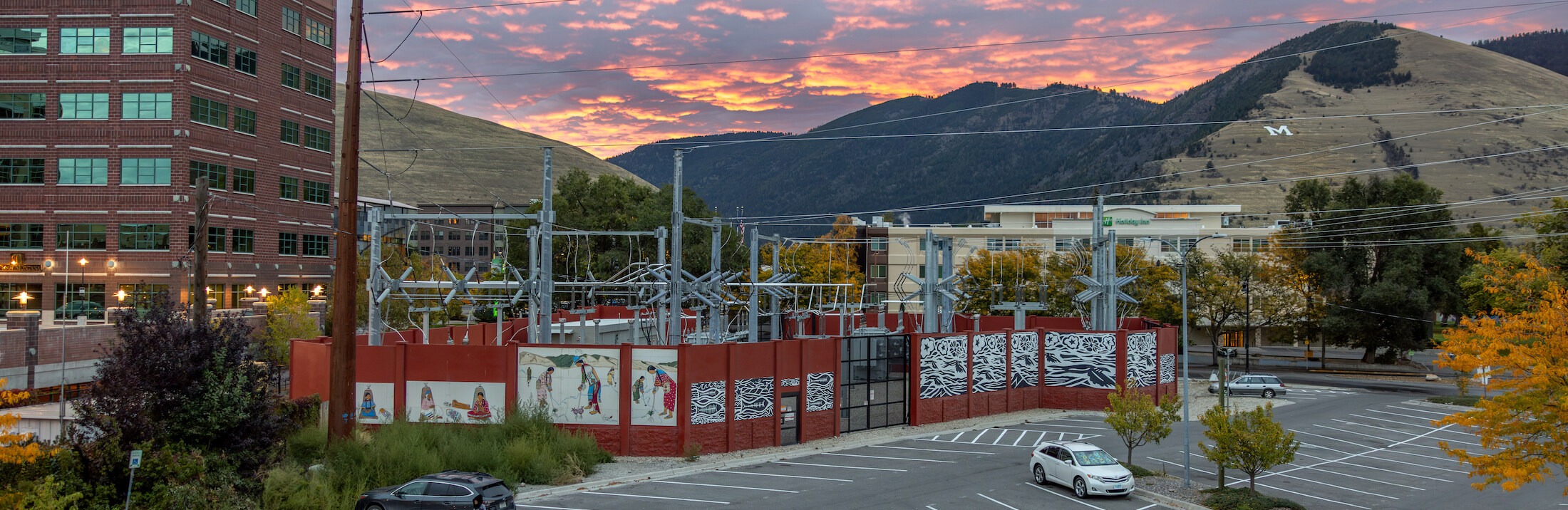
DRAW Indigenous Murals encompasses roughly 4,700 square feet of concrete walls, with 3,804 square feet covered by murals that show the poetry and visual art of 10 Indigenous artists from Montana. Each wall tells its own story and has a distinct character.
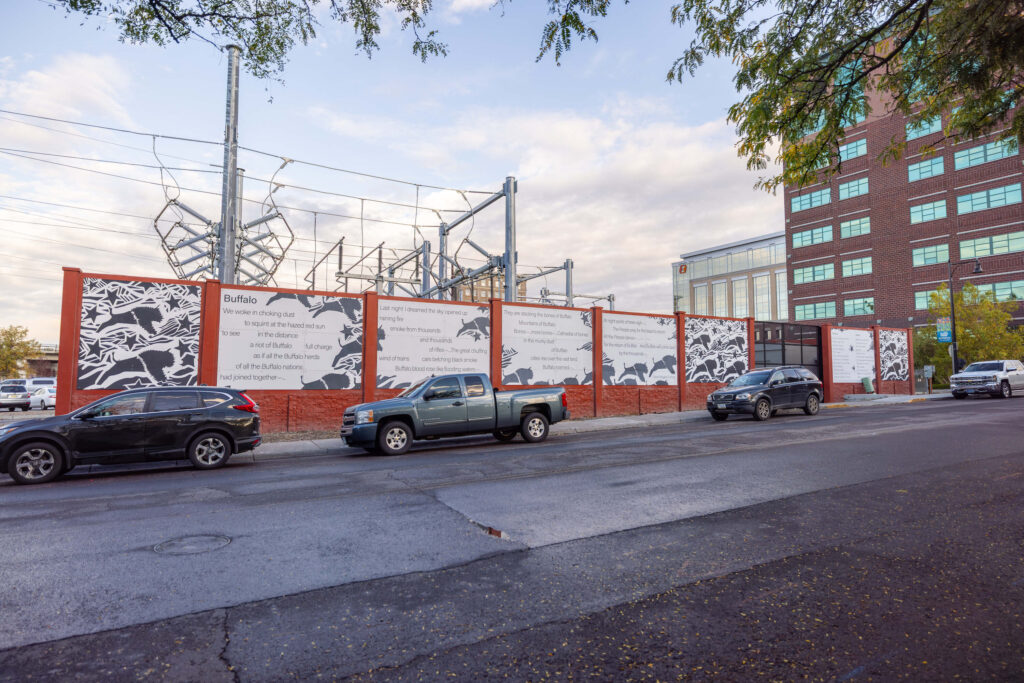 The east wall
The east wall along Pattee Street was the first phase planned. The poems and the visual art of the east wall celebrate the importance of Buffalo to Indigenous cultures, rooted in language, culture and storytelling. Lisa Simon, as Creative Director, proposed including Native language—particularly Salish—as an important part of the project, signifying its value and reversing 20th-century policies that suppressed Native languages. She reached out to prominent Indigenous poets Vic Charlo and Debra Magpie Earling. After choosing a poem titled “Buffalo,” by Vic Charlo, which is translated into Salish by his daughter April, the theme of buffalo emerged for the entire wall. Vic’s poem offers a prayer for the buffalo's longevity, signaling that these revered animals are essential to his people's physical and spiritual survival. Debra Magpie Earling's Buffalo poem likewise raises a powerful invitation to dance, to join in a celebratory stampede across the land, marking the fulfilled promise of the buffalo’s return. These voices are complemented by the stylized artwork of Frank Finley, whose "Buffalo Charge" print is woven behind and through the text.
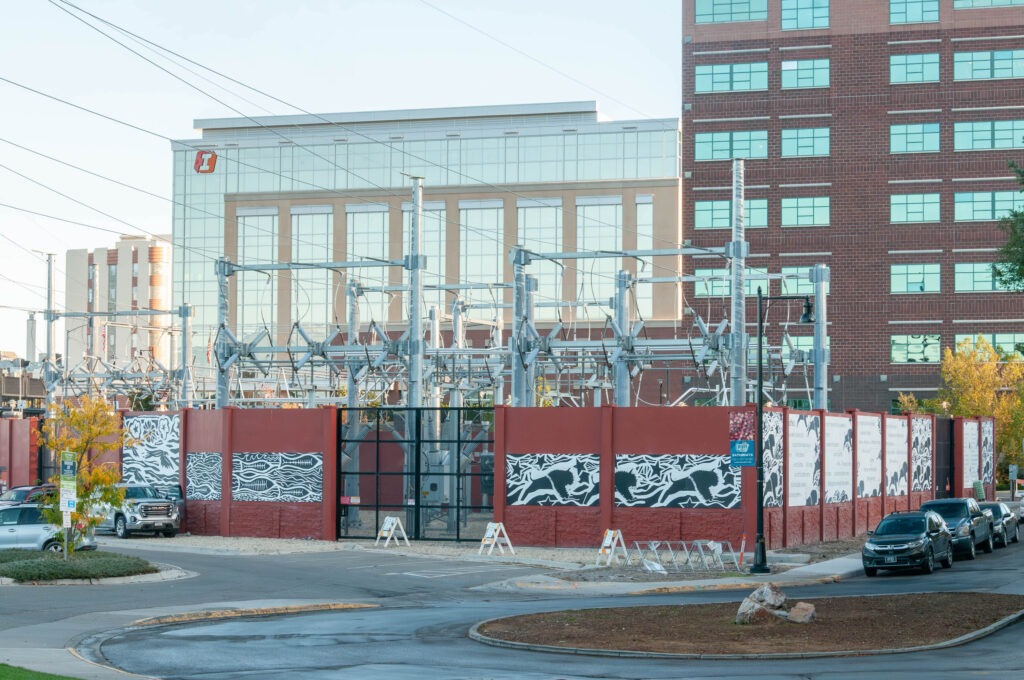 The south wall
The south river-facing wall presented a different curatorial challenge because of its highly irregular shape and the power lines above it, which limited mural height in places. It’s also the wall most visible from Beartracks Bridge—a major walkway through Missoula. The task was to find a calming, cohesive artwork that could stand out against the chaotic foreground of the parking lot and Saturday markets while remaining visible and inviting from the farthest point of the bridge. The answer came in the form of Salish artist Frank Finley’s distinctive black-and-white prints. His bird and fish imagery also made sense of the different heights, wherein the birds occupy the taller sections while fish fill the lower ones. Finley’s prints also stylistically connect to the east, buffalo-themed wall.
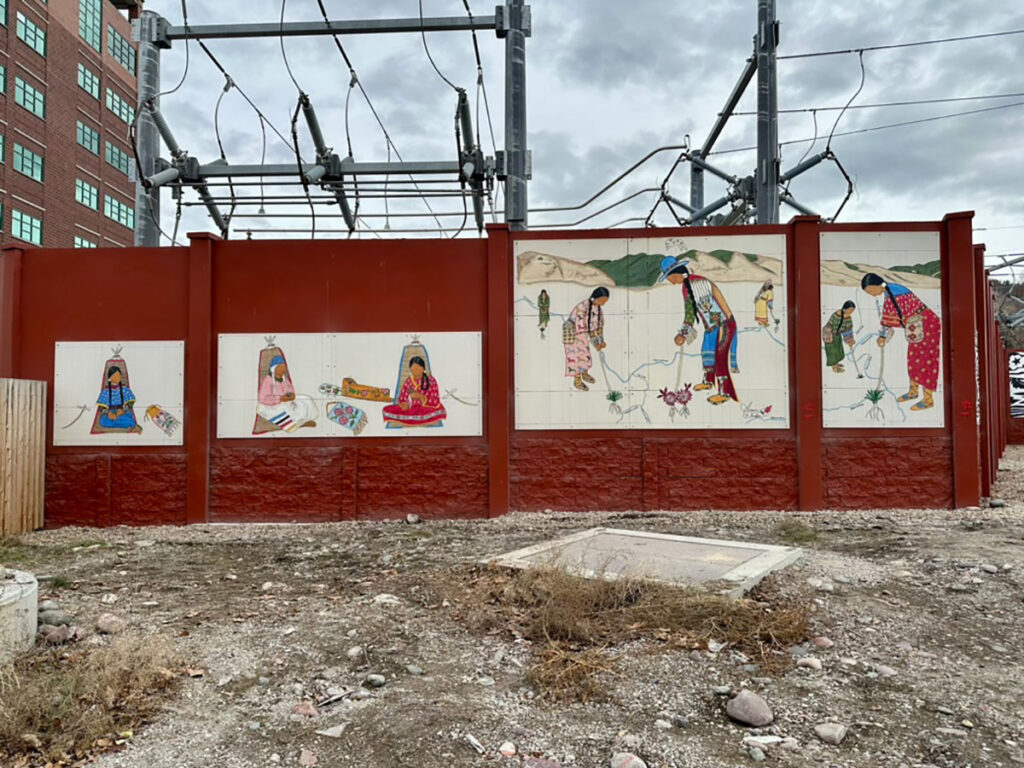 The west wall
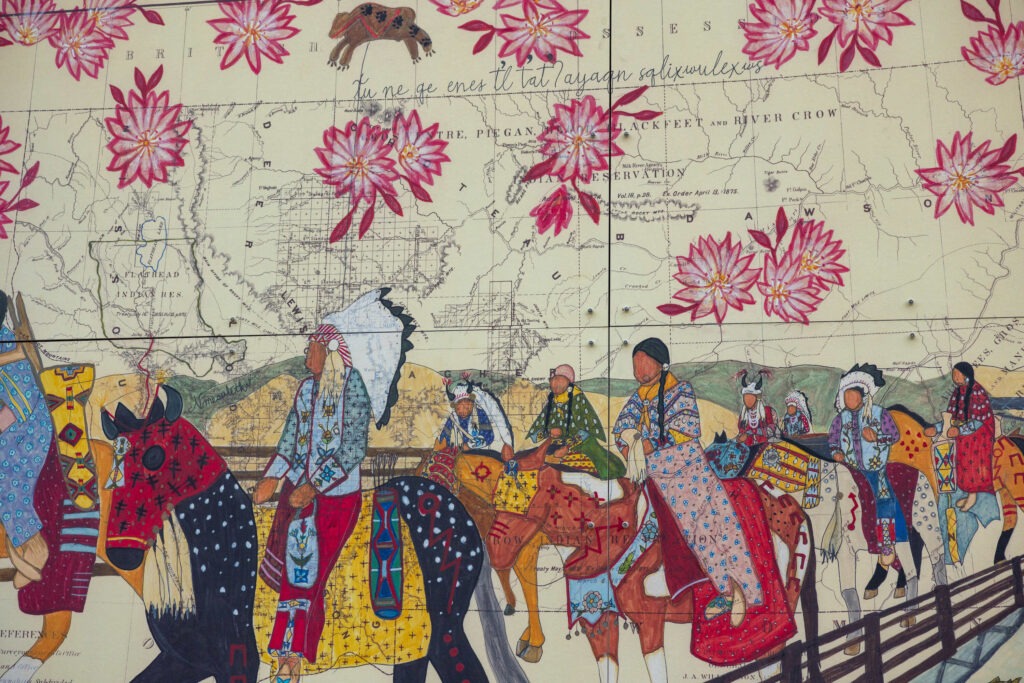
As the shortest wall, the west wall holds just 4 ledger art panels with artworks by Salish artist Aspen Decker depicting a bitterroot harvest at the river, now known as the Clark Fork. The murals illustrate various stages of digging, cleaning, and processing this traditional Salish food source. One prominent figure on a mural panel is Aspen’s 4th-great-grandfather, Alexander Beartracks, whose Salish name, Sxʷúytis Smx̣e, translates to Grizzly Bear’s Tracks. Beartracks signed both the Hellgate Treaty and Judith River Treaty in 1855. These murals face Beartracks Bridge, named in his honor. They thoughtfully connect the murals to specific points of Salish and Montana history. For many years of the project’s development, the west wall was going to be left blank, but a generous donation by a single donor allowed for the commission of Aspen’s 4 thematic pieces and presents a meaningful connection to the adjacent bridge. Aspen’s ledger work on the north wall also features the bridge over the Clark Fork river; the scene depicts what is known as “the removal,” when the Salish tribes were forced to leave the Bitterroot Valley and move onto the Flathead Reservation in 1891. Look closely at any Aspen Decker ledger work and you’ll find, in her distinct cursive writing, Salish names for places and items—once again, a nod to the revitalization of Indigenous languages in the last twenty years.
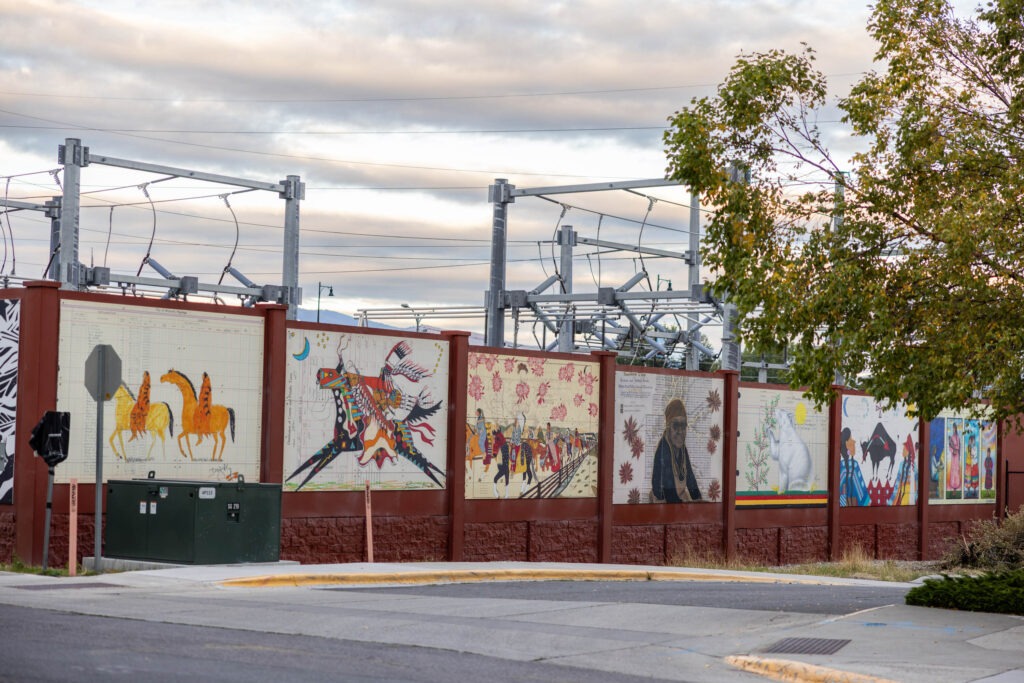 The north wall
The long expanse of the north wall, with its adjacent sidewalk, allows for a mural viewing at a closer range. To take advantage of this more intimate proximity, 7 distinct ledger artworks were commissioned. The curatorial team imagined that, as viewers walked along the expanse, they could begin to appreciate the genre's amazing variety, as each one adds to our understanding of the breadth of traditional ledger topics, the stylistic individuality of these artists, and the cultural resilience of Indigenous people.
David Dragonfly (Blackfeet), Terrance Guardipee (Blackfeet), Aspen Decker (Salish), Monica Gilles-BringsYellow (Huichol, Nahau), Louis Still Smoking (Blackfeet), John Isaish Pepion (Blackfeet), and Rachel TwoTeeth-Picardo (Chippewa, Cree, and Pend d'Oreille) created the ledger artworks. Originally, there was room for only five murals, but Missoula Water agreed to relocate a fence—with Missoula Parks and Recreation funding the move—to create space for two additional artworks.
The decision to feature a variety of ledger art grew out of a phenomenon that local art gallery owners, Lisa Simon and Jason Neal, had been seeing in the region for quite some time—the steady re-emergence of an art form unique to this area.
The dramatic size of the substation walls and centrality of their location in Caras Park presented an amazing opportunity to celebrate an art form that literally developed in this area over thousands and thousands of years. As a contemporary art gallery in Missoula, Radius Gallery had been exhibiting ledger art for some time and knew visitors were captivated by the combination of literal and symbolic storytelling from distinct Indigenous cultures—Salish, Kootenai, Blackfoot, Chippenwa, Cree, to name a few. And, as interest in the genre grew, many talented Indigenous artists were able to make a living through art, adding to the richness of Missoula’s creative culture. Simon explained that “these monumental murals give passersby a chance to encounter Indigenous storytelling as a living tradition. Since this history is often not taught in schools, both locals and tourists are eager to learn. The storytelling nature of ledger art is beautifully didactic and comes from the culture itself.”
Simon shared a brief overview of ledger art:
“The story of ledger art reaches back way before written history, as Plains Indian tribes passed along cultural knowledge as pictographs, petroglyphs, and paintings on animal hides. After the arrival of Non-natives, the deliberate eradication of buffalo severely disrupted traditional Tribal life, yet the practice of conveying culture through pictorial storytelling carried on, adapting to fabric, paper, and discarded ledger books. The shift to paper especially allowed the tradition to live on—recording lives, seasons, heroic tales, love interests, and dreams of better days–as it had for a millennium.
Ledger art entered the discourse of American Art in the mid-twentieth century, when it was recognized as an important genre wholly unique to this country—equal parts cultural knowledge, stunning aesthetics, and powerful individual expression. In the last 30 years, its practice among Indigenous artists has flourished, diversified, and continues to evolve. We look to it for beauty, for wisdom, for an expansion of our thinking.”
Learn more about ledger art on Radius Gallery’s website.
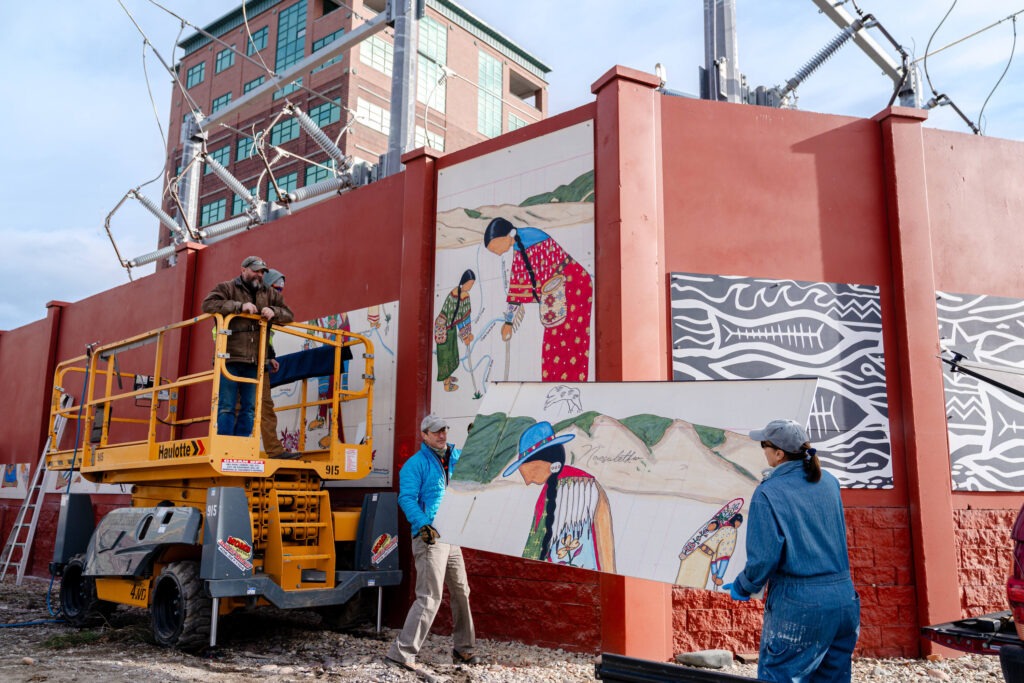
While the murals are huge (up to 10 feet tall), and place Indigenous art on display at a monumental scale, some of the original pieces are surprisingly small. Two of Decker’s largest originals were only 10x11 inches, and some of the smallest works were only 5x8 inches.
Each artwork was scanned, then digitally prepared by Lucy Rummler, Landscape Architect for the City of Missoula, to be enlarged dramatically, while preserving the detail of the original artwork and minimizing the number of cuts needed for installation. A company in Philadelphia printed the oversized images, which are adhered to the wall using a specialized mural gel. The Herculean task of installation was taken on independently and in a volunteer capacity by Karen Sippy and her husband, Brian. Inch by inch, gallon by gallon, bolt by bolt, year by year, the project came to life. By the time DRAW was completed, Karen and Brian Sippy had personally worked across every square inch of thousands of square feet of mural for over 600 volunteer hours. “It is a labor of love for this community we both love,” she said.
According to Sippy, the community response is already visible. “Without fail, while we are installing the murals people will drive by, roll down their windows and yell ‘Thank you!’ or stop and talk to us and express excitement about the project,” she says. This enthusiasm captures the essence of Missoula’s love for the arts, and for Sippy, what she hopes DRAW ultimately says about Missoula.
DRAW is about much more than beautifying concrete. It is about community. Sippy sees the project and its location as a key part of Missoula’s “third place”—the public spaces where people gather beyond home and work to celebrate, recreate and form relationships. DRAW expands that idea by creating a highly visible space where Indigenous art, language and culture are not simply present, but at the center.
The artists chosen are intentionally Montana artists, and the project also seeks meaningful representation among women artists. Interpretive panels, placed around the project and written by Dine artist Cameron Decker, will help illuminate this history and significance. For Missoula’s Indigenous community, the project creates a highly visible place for Native artists, language and stories in the heart of downtown.
Looking at the nearly finished project, Sippy says she wants people to see what makes Missoula so cool and special, but also to see that this community wants its Indigenous members to have a major voice—and a place for their art and language at the center. The project is not quite completed! The next steps include dynamic on-site interpretive signs around the walls, a documentary film, and a dedicated web page on the Downtown Missoula Partnership website.
The most important part of this project is giving these artists a platform to share their cultural knowledge and individual expression more widely. Original artworks by these artists are available locally at Radius Gallery.
Aspen Decker
Tatayaqn, Qlispe & Sqlse (Confederated Salish and Kootenai Tribes)
Bitterroot Removal
Aspen Decker’s work brings Salish history and Nseliscn ‘Salish language’ alive through color and story. Aspen’s artwork shows the removal in 1891 when the Salish people were forced from their ancestral homelands onto the Flathead Reservation. The unique and intricate patterns and beadwork on the regalia of the riders, as well as their horses, identifies them as Salish and signals their familial connections and often, their status within the Tribe.
She notes: “I am deeply rooted in Montana. My connection to this land is inseparable from the history and culture of my Salish and Kootenai ancestors, who have called this place home for thousands of years. As a Salish language speaker and ledger artist, my artwork connects to my Sqelixw ways of knowing.”
Terrance Guardipee
Amskapi Piikani of the Blackfeet Confederacy
Running Eagle: Blackfeet Woman Warrior
Terrance Guardipee pieces together the intersection of the spiritual and physical world to reflect Piikani worldview. His mural artwork depicts one of the most famous women in Blackfeet history, Running Eagle, and each painted symbol–in the sky, her regalia, and the horse–connects to Blackfeet symbology and worldview.
Guardipee notes: “I am not reinventing anything. I’m not trying to change what was created by my people thousands of years ago. My art is being created inside and out of my spirit, soul, and mind. I see myself as a Blackfeet. People see many different things in ledger art, and I want the feel of original works with a modern twist in the colors, shapes, and figures I use.”
Louis Still Smoking
Blackfeet Confederacy
Nature’s Blanket
Louis Still Smoking pushes ledger art into the present, using the form to explore what it means to be Native in the contemporary world. The colors and content of his mural expresses the kinship the Blackfeet hold with bears, which they consider sacred and do not hunt. Rather than killing or conquering the bear, Still Smoking explains, “the Blackfeet often pick berries next to bears. The land supplies for us both. Nature provides bounty, of colors, of food; we share a survival instinct.”
Still Smoking notes: “My art expresses my own beliefs and struggles as a modern Native American. I want to move people; I want to have a voice in the world. If you move people, you are doing your job as an artist.”
David Dragonfly
Blackfeet, Assiniboine
Riding the Seasonal Routes
David Dragonfly reclaimed ledger art in the early days of its revival and gave it new life, carrying the tradition into the future. David Dragonfly passed away in October of 2024, but his legacy lives on in his enduring artworks. We selected this piece, and placed it prominently as the first mural, because of its touching depiction of buffalo hide paintings used as robes, draped around the horseback riders. . The hide paintings signal this art’s original cultural use. It was only in the 21st century that this form of drawing became art made intentionally for hanging on walls.
Dragonfly noted: “I like using the names of people because we didn’t have a written language; it was a pictorial language.”
John Isaiah Pepion
Piikani Band of the Blackfoot Confederacy
Our Story
John Isaiah Pepion draws on traditions of pictographic storytelling, illustrating the heart of Piikani culture. His mural depicts the origin story of the Blackfeet, with Father Sun and Mother Moon and their child Morning Star, centered above the buffalo, a mainstay of their traditional sustenance.
Pepion notes: “When I do my ledger art, I am continuing to find out who I am as a person and who my family is, especially being Blackfeet in Montana. Ledger art is a contemporary winter count, a way of documenting our lives, our history, our identity, and our stories. The old ledger pages already carry history, and I add another layer through a Blackfeet perspective. The materials may have changed, but the need to tell our stories has not. I’m not just drawing on old paper; I’m adding another page to our story and carrying it forward for the next generation.”
Frank Finley
Salish
Three murals: Buffalo Charge, Raven & Trout
Finley’s stylized prints connect to ledger art as both look to early pictographs and petroglyphs. These ancient markings, found throughout Montana, are sacred and irreplaceable links to thousands of years of Indigenous history, spirituality, and land use.
Finley notes that his murals “bring knowledge of the Indigenous people to people that visit Missoula, people that live here, and I'm sure that there are people here that don't know that this is the homeland of a native peoples. The murals bring all that together, bring it into a sharper focus.”
Rachel Twoteeth-Pichardo
Little Shell, Chippewa, Salish and Kootenai
Beaded Together: Grandmothers, Mothers, Sisters & Daughters
Rachel Twoteeth-Pichardo explores cultural preservation and sharing stories, incorporating themes of family, love, and appreciation for her culture. While much of the ledger paper used in this genre holds an arbitrary connection to the vibrant drawings, in Twoteeth-Pichardo’s mural, the papers derived from her grandmother’s trading post, providing a layered connection. This mural depicts that important female familial line.
She said: "My work is inspired by lived experiences, traditional knowledge, family stories, and the desire to share how I see the world. Through contemporary ledger art, I bring together the past and the present, using papers that hold personal meaning to tell my stories. I hope people see themselves, someone they love, or a familiar feeling reflected in my work. Most importantly, I hope to inspire other Native people to share their own stories, whatever form they may take. Our voices belong everywhere, and our presence, creativity, and beauty deserve to be seen and celebrated."
Monica Gilles-BringsYellow
Huichol, Nahau
Agnes Vanderburg and the Bitterroot
Monica Gilles-BringsYellow brings overlooked individuals to the forefront, using ledger art to recognize lives behind historical images. Her mural portrays the important Salish cultural leader Agnes Vanderburg, who for many years held a summer “Culture Camp” on the Flathead reservation for both adults and children, passing on specific knowledge of craft and food preparation. Her teachings influenced many and, most importantly, provided a counter tack for the expected assimilation of Natives by non-Natives.
Gilles-BringsYellow notes: “A lot of the time you will see paintings of people, but you will have no idea who they are. Nobody talks about what happened in their lives, so this is a chance to give them respect that I think they have much deserved.”
Debra Magpie Earling, poet
Salish
Debra Magpie Earling’s novels Perma Red and The Lost Journals of Sacajewea are must-reads for anyone interested in Indigenous culture. In 2024, Perma Red was named one of the Great American Novels by Atlantic magazine. Earling wrote the buffalo poem on the east wall especially for this project.
"Although Buffalo were nearly decimated---their life messages cannot be erased. Buffalo show us that good works help all to prosper as Buffalo pathways create new life that sustains the Earth. Buffalo remain our lodestar to honor freedom and to resist colonization and restraint. That is why Buffalo are so powerful. Buffalo are living symbols of amity. We might hear only fragments of lessons we’ve been gifted by Buffalo, yet even shattered messages become prayers and chants that conjure good change. The Bitterroot Salish revere our sacred relatives the Buffalo. And Buffalo tell an ancient story of wisdom, sacrifice, and survivance. I listen. I write."
Vic Charlo, poet
Salish elder
Vic Charlo is a direct descendant of the Salish chiefs who signed the Hellgate Treaty of 1855. He attended Agnes Vanderburg’s culture camp and dedicated his last book, Put Sey, to her. This same volume of poems contains “Buffalo,” the poem selected for the east wall. His daughter, April Charlo, translates his poems into Salish.
April Charlo notes “There was a time that signs in the windows of some Montana businesses once read 'No dogs or Indians allowed’. Those who fought through that, and fought through colonization, in order to be able to pass this language down — these murals honor them.”
The DRAW Indigenous Murals Project is located on the walls of the NorthWestern Energy Substation located at 201 S. Pattee St. in East Caras Park. Check out the inspirational works by these artists next time you find yourself in downtown Missoula.